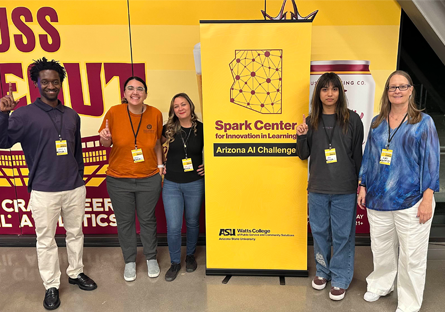
A team of South Mountain Community College students participated in The Spark Center for Innovation in Learning (SCIL) Arizona AI Challenge hosted by Arizona State University on November 7-15, where they placed second overall for a prize of $3,000.
The challenge invited teams of students to design, build, and pitch AI-powered solutions with the intent to help neurodiverse individuals with post-college success. This opportunity was open to all Arizona students from the higher education community and featured over 20 teams with approximately 100 participants from across the region.
Starting on November 7, students had five days to develop their ideas from start to finish with the support from mentors. On November 15, they pitched their final prototype to a jury.
The SMCC team, which was named “Salutogenic AI”, included Isaac Leki, Jazmyn Escobar, King George Omari, Sai Sudha Piratla, Stephanie Brooks and Vittorio Barocio. Kari Locke (SMCC Computer Science Faculty), Niall McCarthy (SMCC Computer Information Systems Faculty), and Dr. Bruce McHenry (SMCC Faculty Chair, My Career, Library, Center for Teaching and Learning) served as the faculty mentors for the team.
“Salutogenic AI” was formed after each student individually registered for the challenge with the encouragement from SMCC faculty. The group represented different backgrounds and interests, including students from SMCC’s Introduction to Computer Science course, a BHS student, and an ASU student. The faculty mentors were then matched with the team based on their expertise and availability to be present as support throughout the days of the challenge.
Throughout the five days, the team collaborated both on the SMCC campus and off campus at locations like First Place, a local organization that provides independent living for adults with autism and/or neurodevelopmental disabilities. Through these in-person and virtual meetings, they were able to develop their idea, Start Buddy.
Start Buddy is an app that the students designed to assist post-college ADHD neurodiverse individuals with executive functioning challenges. The idea was born once the team identified a genuine need in supporting these individuals, an approach that showcased their technical skills and social awareness in addressing a real-world problem that affects millions of people.
After presenting their creations, which consisted of a demo of the app and a video pitch, “Salutogenic AI” was awarded the honor of second place with a $3,000 prize.
This distinction represented not only the consistent hard work that was poured into this project by each team member, but the opportunity to take the skills they have learned along the way on their higher education journey to apply in practical situations.
“SMCC fosters interdisciplinary collaboration between computer science and health sciences students, emphasizing practical problem-solving and real-world applications. This challenge provided an opportunity for our computer science and health sciences students to combine their skills on a meaningful project that could genuinely improve people's health outcomes and quality of life,” said Kari Locke, SMCC Computer Science Faculty.
This rewarding opportunity allowed the students to work together to successfully bring their ideas to life through their creativity, collaboration, shared goals, and ability to stand amongst the best of the best.
"This achievement demonstrates that our students—across computer science and health sciences—can compete at the highest levels while staying true to SMCC's mission of accessible, community-focused education. For students interested in technology, healthcare, and AI-driven solutions, this shows that meaningful innovation and impact aren't limited to major research universities—they can happen right here when diverse perspectives come together, and we're committed to providing more opportunities for this kind of interdisciplinary collaboration," said Locke.
With their second-place title, “Salutogenic AI” now has the opportunity to advance to The Spark Center for Innovation in Learning (SCIL) Global AI Challenge on December 7.