I wanted to make sure our stories didn’t disappear. If we didn’t write them down, nobody else was going to do it for us.
Written by SMCC Student Joselyn Diaz
Over the course of Nelson G. Mitchell III’s life, he witnessed the transformation of the Okemah farming community into an urbanized part of Phoenix. As South Phoenix changed around him, he experienced shifts in community identity, increasing racial tension and the pressure of urban development.
Mitchell saw firsthand how projects like freeway construction reshaped daily life and challenged long-standing neighborhood ties. Through these experiences, he developed a deep understanding of resilience within his community. His story reflects how individuals living in South Phoenix confronted and adapted to the forces that reshaped Arizona in the twentieth century.
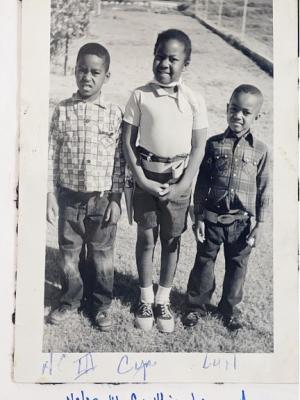
Nelson G. Mitchell III was born on July 15, 1953, in Phoenix, Arizona, and grew up in the semi- rural Okemah community of South Phoenix. His childhood revolved around his family’s small farm, where they raised cows and chickens and relied on close-knit neighborhood traditions.
At the time, South Phoenix remained a rural agricultural pocket shaped by family labor and community cooperation. Growing up in Okemah gave Mitchell a sense of connection to the land and a deep awareness of how families survived by working together.
As he remembers, “My family raised cows and chickens, and we all learned to fish together. Growing up in Okemah, everyone knew everyone and helped each other out.”
One of the most significant events Mitchell witnessed was the construction of Interstate 10 in the early 1960s. The freeway cut directly through his neighborhood and claimed part of his family’s property, accelerating the decline of Okemah’s rural landscape and reshaping daily life for longtime residents.
The project marked a turning point, revealing how easily outside development decisions could disrupt and displace marginalized communities. As Mitchell recalls, “They came through with the bulldozers, and suddenly everything looked different. It felt like our whole world was being pushed aside.” At this time, Arizona was undergoing rapid urban growth that placed pressure on historically rural and segregated areas like South Phoenix. The 1960s brought major civil rights struggles that exposed inequality in schools, policing, housing and public planning.
Projects such as freeway construction and industrial zoning disproportionately affected Black, Latino and working-class communities. As Phoenix expanded, South Phoenix residents faced displacement, diminished land ownership and increased segregation through city planning decisions. The transformation of Okemah into an urban corridor reflects broader state and national trends that reshaped communities during the mid-twentieth century.
Mitchell later became an editor and communicator, contributing his skills to community organizations focused on education, cultural preservation and neighborhood storytelling. He worked on newsletters, local history projects and publications that highlighted the experiences of South Phoenix residents, especially those whose stories were often neglected in mainstream accounts.
Through this work, he helped document community events, preserve family histories and amplify local perspectives on urban change. Mitchell’s role shows how everyday residents can shape collective memories by recording the voices around them.
Reflecting on this chapter of his life, he explained, “I wanted to make sure our stories didn’t disappear. If we didn’t write them down, nobody else was going to do it for us.”
Today, Nelson G. Mitchell III remains connected to the South Phoenix community, sharing his experiences and helping preserve its history. His memories continue to shape contemporary understanding of urban change in Arizona.
Mitchell was interviewed by South Mountain Community College students on January 31, 2024, on behalf of the South Phoenix Oral History Project.